Well, that is what this guy claims...
It's not gravity you see -- it's because fluids magically seek their own level.
There is just one little problem... When you remove gravity the fluids no longer know which way is down and no longer have the magic to 'seek their level' just due to air pressure.
So he's just Flat Out Wrong.
Monday, August 29, 2016

Thursday, August 25, 2016
Flat Earth Follies: LAX to LHR Flight Path Takes You Near Iceland
YouTuber 'Flat Earth Addict' (a good term for them, they know it's bad for them but they can't quit) wonders why a flight going from the UK to LA passes near Iceland?
NO DUH
BECAUSE THAT IS CLOSE TO THE SHORTEST PATH ON THE GLOBE

Because both points are well into the Northen Hemisphere his line on Gleason's azimuthal equidistant projection (projection FROM A GLOBE, LOL). Beyond that point the Gleason map IS TERRIBLE -- sizes, distances, compass headings, everything is far worse than on the Mercator projection. The ONLY thing accurate on the azimuthal equidistant projection is distances TO THE CENTER POINT. All other distances are WRONG and they get more and more WRONG as you go further 'South' (towards his outer edge).
Notice how the paths are ALMOST identical? What is this guy trying to prove exactly?

You can find the story, such as it is, here:
Why did American Airlines flight travel 1,000 MILES back to London instead of landing in Iceland after medical emergency?
and a little more detailed here. (sounds like maybe aerotoxic syndrome)
All this proves is that they likely were close to Iceland which fits perfectly well with the Spherical Model Earth.
FlightAware shows the actual flight path on the Mercator projection with a dotted line taking it a little closer to Iceland than a straight-line distance -- this is not usual for many reasons including safety, flight congestion, and legal. The line isn't straight on the Mercator projection because it PURPOSEFULLY distorts areas away from the Equator - BUT it does this to preserve compass directions.

Flat Earth Follies: The Horizon Always Rises To Eye Level
The Horizon Always Rises To Eye Level
How did you measure that? Doesn't look LEVEL to me. It's a few degrees below which is EXACTLY what you would expect on a spherical Earth of 3959 miles radius from a high altitude.

From this video:
Wednesday, August 24, 2016
General Recommendation: Learn Some Physics
If you want to know more about Physics
Richard Feynman - The Character of Physical Law
The first few entries in that playlist cover the basics of how we know what we know about Gravity.
Watch some physics classes 8.01 Classical Mechanics
Covers all the basics of Classical Mechanics
From there - you can check out more classes in iTunesU (iTunes University) and many other online resources.
Tuesday, August 23, 2016
Flat Earth Follies: PI is 3 because the Bible says so.
I would like to believe that this is a joke... A YouTuber named 'Awake Souls' claims that PI is really maybe 4 or probably 3, because the Bible says so mainly.
It's a 12 minute tour de force of nonsense and non sequiturs that rambles between ancient history, conspiracy theory, Biblical appeals, and Indiana Law from 1897 (HB 246).
But let's just take a quick look at what PI actually is and why it is certainly neither 4 nor 3.
PI is JUST the ratio between the circumference of a circle and the diameter of that circle. That's it, there is nothing magic about it. All circles, no matter their size, have the same ratio. Which is pretty cool because it means that if we know the radius of the circle we can figure out the circumference and area also, or vice versa. All it really means there is a relationship between these measurements.
Finding a close approximation of PI is very easy.
Just find something that is very round and then take a string that doesn't stretch (fine thread works) and wrap it around your round cylinder (a tube or pipe that is uniform works, the larger the better) and mark it exactly once around -- measure that length with a finely marked ruler. That is the Circumference. You can also try to "roll" it along a flat surface and carefully mark & measure "once around".
Now measure the Diameter of the outside of that cylinder very carefully - just make sure you go as straight across as possible.
Now divide the length of the string by the diameter of the cylinder: C / D or Circumference / Diameter.
That's it - you have an approximation of Pi and it will very clearly be neither 3 nor 4.
Depending on how accurately you measured you'll find it's pretty close to 3.14 etc etc. The more accurately you measure it, the closer you'll get to 3.14159265 etc etc
I used a soda can. I cut a strip out of it so I could flatten that strip and measure it, it was ~207.5mm. I then measured across the can and got 66mm; 207.5/66 = 3.1439...
Beverage Can wiki says it's actually 2.6" wide which is ~66.04mm, which gives us: 3.1420 - a very good approximation without any hard work. I did this in under 5 minutes. We're far enough from 3 that PI is clearly not 3 - and we're very far from 4 so that's just ridiculous.
I went back today and remeasured everything in inches and took pictures. This time I got approximately 8 5/32" by 2.6" which gives me a ratio of 3.137. Even though measuring things super accurately is hard, we are nowhere even near 3.
Little bit of error introduced here because the edge didn't quite line up:


For our circumference, I laid the strip out flat and measured it - was a little off here:
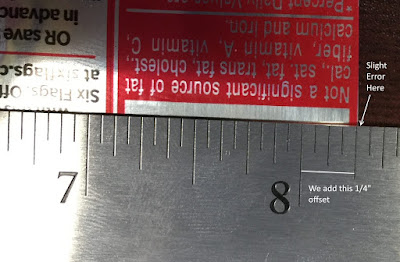
And on the other end we have 1/32nd inch marks (that's why I shifted it by 1/4"):

Can you get closer? Try to borrow some very accurate calipers and see.
And it's also very easy to verify that doesn't matter if you measure in millimeters, inches, or anything else. The ratio doesn't depend on the units used -- just make sure you use the same units when you measure (or convert them to the same units).
You can also get it using an approximation of PI using the function |sqrt(1-x^2)| which gives you an area of π/4 over the range x = 0 to x = 1 (because it makes a little 1/4 circle).
Take few values and just treat them like little rectangles and add up the area - like this image:

I did a little example in Excel, I use the average point between each sample for my height and each width is 0.1 units. Here are the Excel details so you can recreate it. I'm just doing one quarter of the circle - same function as above but x just goes from 0 to 1.
This gives us the following calculation:
All we've done here is add up all the little areas of each rectangle.
We're off, as expected, a little bit because our pieces are too big. Break those up into 100 pieces and you get much closer (I got 3.140417032). Break it up into 1000 pieces and you get even closer. So you are adding up smaller and more accurate pieces -- when you get to an infinite number of pieces you'll get the exact value of PI. But it doesn't even matter what the EXACT value of PI is here -- the point is it just absurd to say it's 3.
There are lots of other ways to approximate Pi
But let's just take a quick look at what PI actually is and why it is certainly neither 4 nor 3.
What is PI?
PI is JUST the ratio between the circumference of a circle and the diameter of that circle. That's it, there is nothing magic about it. All circles, no matter their size, have the same ratio. Which is pretty cool because it means that if we know the radius of the circle we can figure out the circumference and area also, or vice versa. All it really means there is a relationship between these measurements.
Approximating PI
Finding a close approximation of PI is very easy.
Just find something that is very round and then take a string that doesn't stretch (fine thread works) and wrap it around your round cylinder (a tube or pipe that is uniform works, the larger the better) and mark it exactly once around -- measure that length with a finely marked ruler. That is the Circumference. You can also try to "roll" it along a flat surface and carefully mark & measure "once around".
Now measure the Diameter of the outside of that cylinder very carefully - just make sure you go as straight across as possible.
Now divide the length of the string by the diameter of the cylinder: C / D or Circumference / Diameter.
That's it - you have an approximation of Pi and it will very clearly be neither 3 nor 4.
Depending on how accurately you measured you'll find it's pretty close to 3.14 etc etc. The more accurately you measure it, the closer you'll get to 3.14159265 etc etc
Coke Can Method
I used a soda can. I cut a strip out of it so I could flatten that strip and measure it, it was ~207.5mm. I then measured across the can and got 66mm; 207.5/66 = 3.1439...
Beverage Can wiki says it's actually 2.6" wide which is ~66.04mm, which gives us: 3.1420 - a very good approximation without any hard work. I did this in under 5 minutes. We're far enough from 3 that PI is clearly not 3 - and we're very far from 4 so that's just ridiculous.
I went back today and remeasured everything in inches and took pictures. This time I got approximately 8 5/32" by 2.6" which gives me a ratio of 3.137. Even though measuring things super accurately is hard, we are nowhere even near 3.
Little bit of error introduced here because the edge didn't quite line up:

Another small amount of error introduced because my cut across the can wasn't perfect so it's slightly tilted:

For our circumference, I laid the strip out flat and measured it - was a little off here:

And on the other end we have 1/32nd inch marks (that's why I shifted it by 1/4"):

Can you get closer? Try to borrow some very accurate calipers and see.
Units Don't Matter to PI
And it's also very easy to verify that doesn't matter if you measure in millimeters, inches, or anything else. The ratio doesn't depend on the units used -- just make sure you use the same units when you measure (or convert them to the same units).
Approximating PI in Excel By Adding Up Little Rectangles
You can also get it using an approximation of PI using the function |sqrt(1-x^2)| which gives you an area of π/4 over the range x = 0 to x = 1 (because it makes a little 1/4 circle).
Take few values and just treat them like little rectangles and add up the area - like this image:

I did a little example in Excel, I use the average point between each sample for my height and each width is 0.1 units. Here are the Excel details so you can recreate it. I'm just doing one quarter of the circle - same function as above but x just goes from 0 to 1.
| Field | Excel Formula |
|---|---|
| |sqrt(1-x^2)| | =SQRT(1-(A2^2)) |
| Area: w x h | =(ABS(A3-A2)*ABS((B2+B3)/2)) |
| area*4 | =SUM(C3:C12)*4 |
This gives us the following calculation:
| x | |sqrt(1-x^2)| | Area: w x h |
|---|---|---|
| 0.0 | 1.00000000 | |
| 0.1 | 0.99498744 | 0.099749372 |
| 0.2 | 0.97979590 | 0.098739167 |
| 0.3 | 0.95393920 | 0.096686755 |
| 0.4 | 0.91651514 | 0.093522717 |
| 0.5 | 0.86602540 | 0.089127027 |
| 0.6 | 0.80000000 | 0.083301270 |
| 0.7 | 0.71414284 | 0.075707142 |
| 0.8 | 0.60000000 | 0.065707142 |
| 0.9 | 0.43588989 | 0.051794495 |
| 1.0 | 0.00000000 | 0.021794495 |
| Area*4 | 3.104518326 |
All we've done here is add up all the little areas of each rectangle.
We're off, as expected, a little bit because our pieces are too big. Break those up into 100 pieces and you get much closer (I got 3.140417032). Break it up into 1000 pieces and you get even closer. So you are adding up smaller and more accurate pieces -- when you get to an infinite number of pieces you'll get the exact value of PI. But it doesn't even matter what the EXACT value of PI is here -- the point is it just absurd to say it's 3.
There are lots of other ways to approximate Pi
Monday, August 22, 2016
Flat Earth Follies: a curve cannot reflect a line/column of light
Several Flat Eathers now have tried to claim that a 'column of light' cannot possibly form on a convexly curved Earth - which is just ridiculous but here we go… all will become clear.
This one I personally took on a sharply convexly curved overpass. Clear columning is observed along the convexly curved surface.

Here we observe it with sunlight all the way over the very clearly convexly curved wave!

And here is a diagram showing why.

And we don't see the full column when the water isn't rippled enough.

It's all about the angles, nothing what-so-ever to do with overall curvature or shape of the Earth.
Conclusive enough?
No, the guy just kept denying and making excuses. Anyone want to try to make a coherent argument against this?
Analysis: Apple Pie Hill to Philadelphia
This is a review of the view from Apple Pie Hill to Philadelphia done by professional surveyor Jesse Kozlowski, executed using a Wild Heerbrugg theodolite (Video).

Technical Data
Observation Point (Apple Pie Hill):
Target (Comcast Center Tower):
Ground: 204'
Tower: 46'
Total: 250'
Target (Comcast Center Tower):
Ground: 42'
Height: 973'
Top: 1015'
Zenith Angle: 89.95389° [89° 57' 14"] // ~166 arcseconds
Distance: 171281' (~32.44 miles)
Instrument (Wild Heerbrugg theodolite):
I do not know exactly which model of this theodolite was being used but looking at several that looked similar I'll estimate that we have a level accuracy of 30" which gives us about +/- 25 feet at this distance. But the specifications for these theodolites indicate that they are good for viewing objects about 12 miles away, so this would introduce additional error in our measurements as the angular size of objects over 32 miles away would be reduced, so roughly we might expect 24.912*(32/12) = +/- 66.432'
With better information here we might be able to tighten up our errors bars a little bit but I think I show below that this doesn't matter and greater accuracy would make the Flat Earth hypotheses even LESS likely.
Analysis Flat Earth
On a Flat Earth model would have expected the distant level point to be even with our observation point at 250', with error bars that means we should see 765'+/-66.432' of the tower sticking out above our level mark. This is well outside the range of even our very generous error bars.
Analysis Curved Earth
Therefore, on a globe, we would expect that extending out a line that is level from our viewpoint on Apple Pie Hill, the elevation in Philadelphia would be the amount of curvature 'drop' (701.74' / 601.49') plus our elevation (250'), or somewhere between 851.49' to 951.74' at the Comcast Center Tower in Philadelphia. That would leave 163.51'+/- 66.432' to 63.26'+/-66.432' above our level mark at the tower.
Based on the zenith angle measurement of 166 arcseconds we calculate the top is an estimated [g = 2r*tan(α/2)] = 138.8' above the level mark - this agrees with the visual mark on the tower so that seems more accurate (indeed the angle measurement accuracy on this theodolite is cited as being 1" so a higher accuracy in this measurement makes sense).
That's a pretty big error bar but our 138.8' is entirely consistent with the view we see with only moderate refraction and accuracy considerable better than worst case.
Conclusion
So, this shows that this view is entirely compatible with a curved Earth of 3959 miles radius and is completely incompatible with a Flat Earth model.
Subscribe to:
Posts (Atom)